Flavia Regaldo
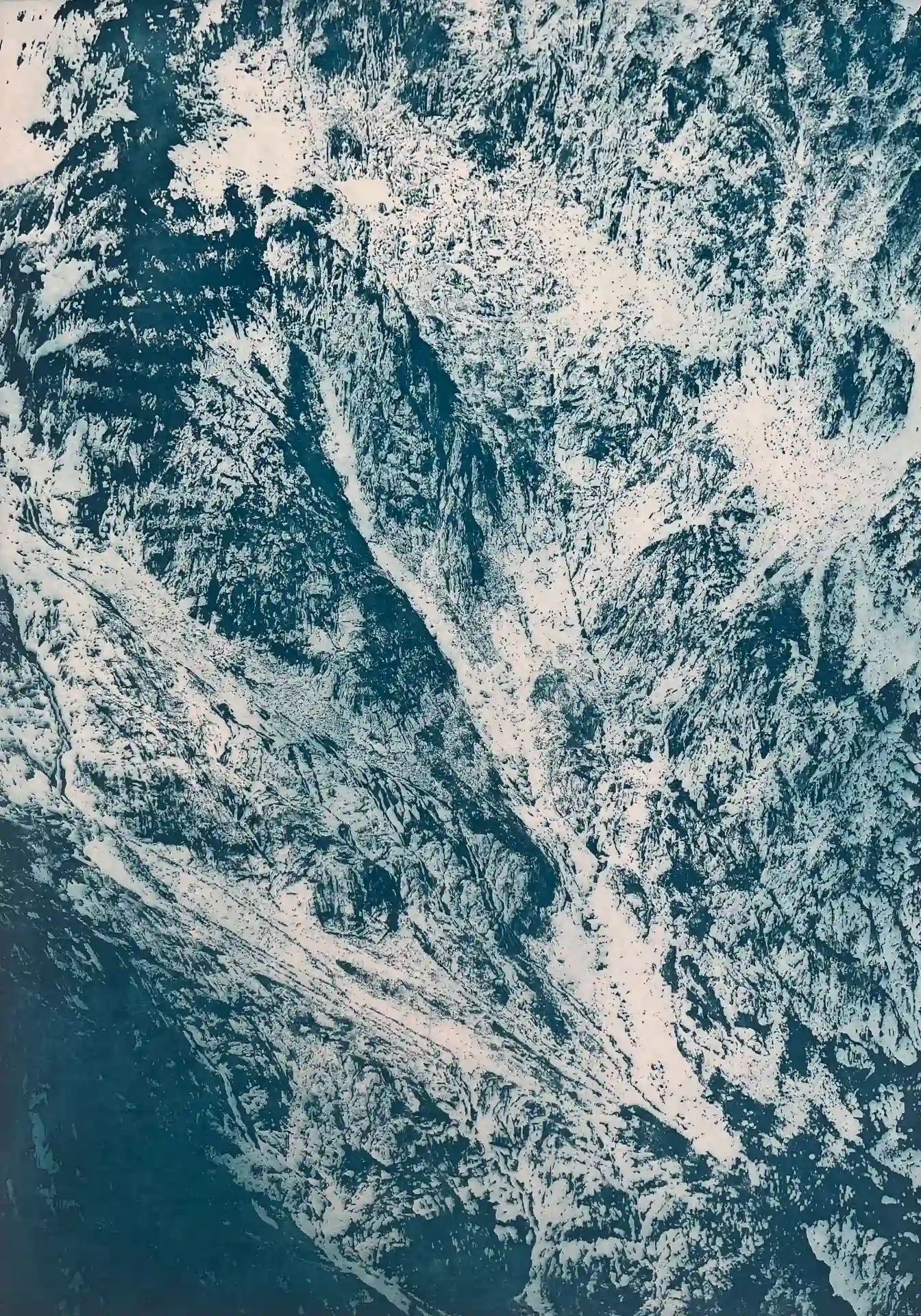
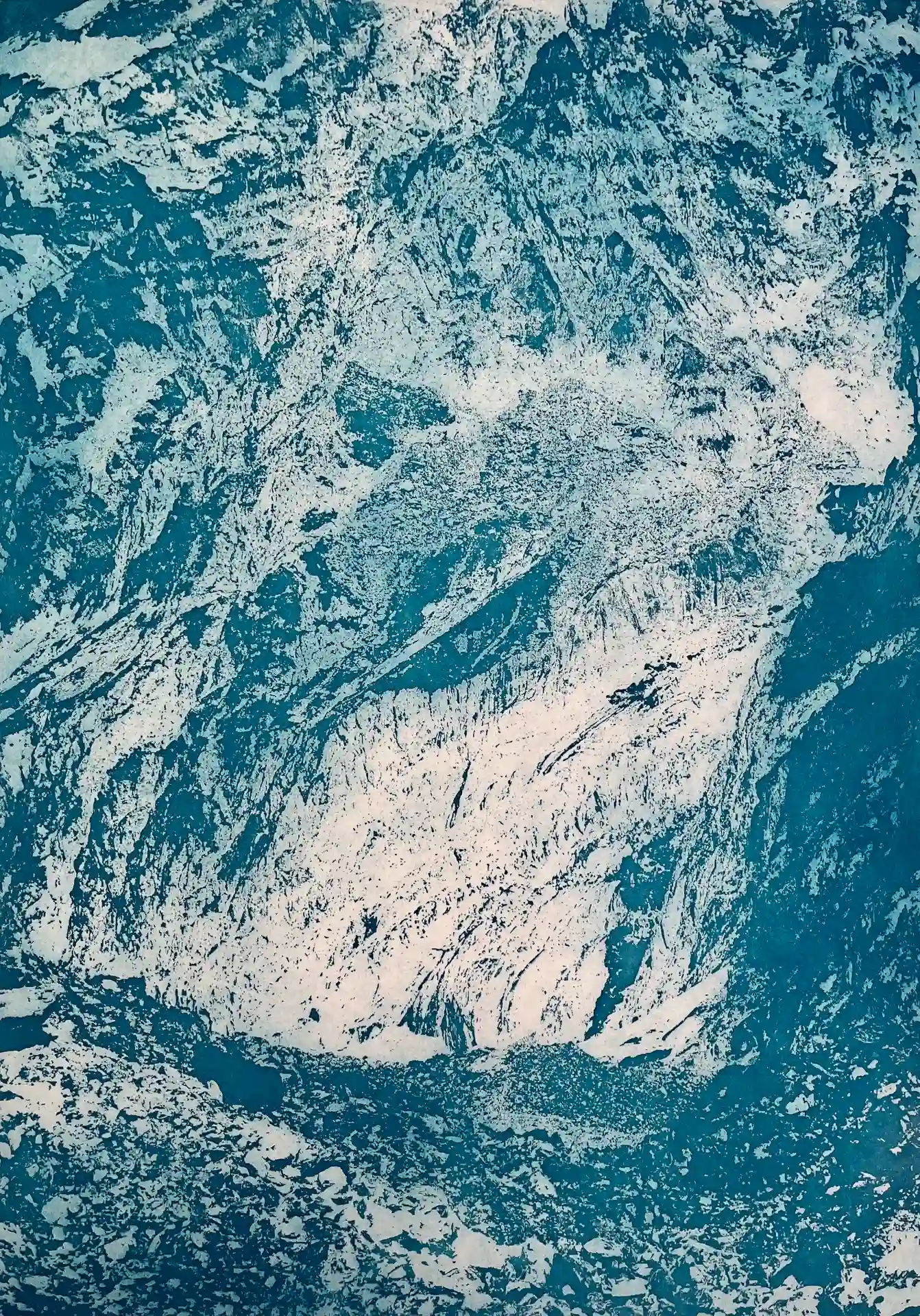
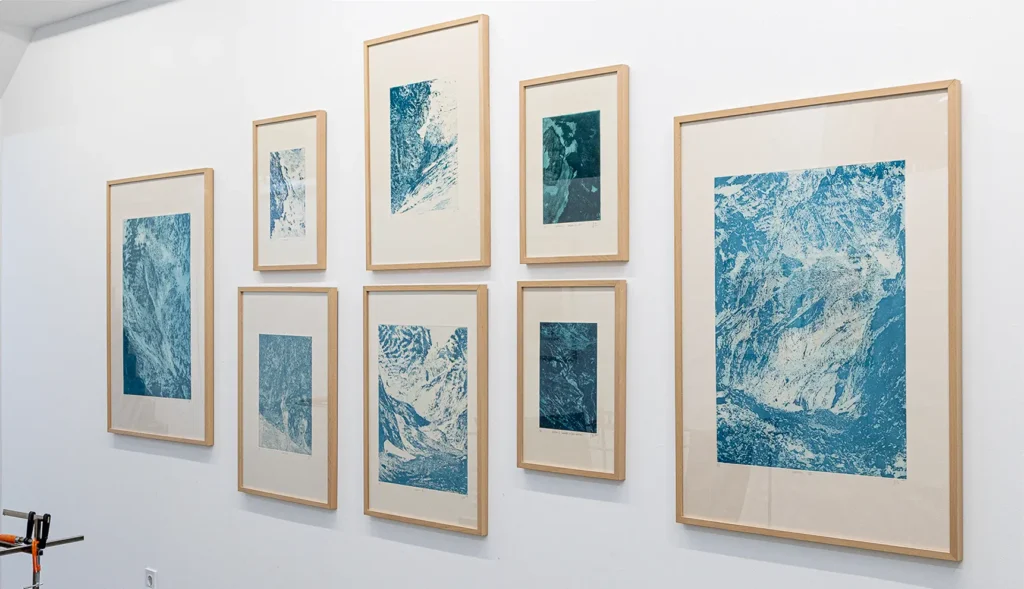
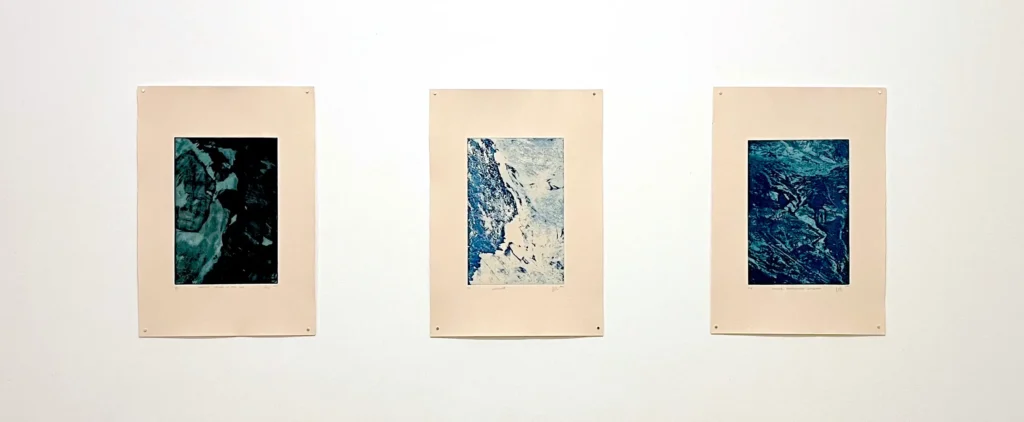
Vertigo contrasts the heights of geological landscapes with the inner depths of fears and affections, considering the melting down of glaciers as a figurative social collapse. Vertigo of time. Vertigo of our times.
How many meters up can one count a conquest? The summit and the precipice. The immensity of the landscape in merge with the fall. The ground. The dream. Myth as a possible form of organisation and meaning. A line in geography of millenary soil tension. The glacier presents itself as a chimera, a dream of height and possession. An outdated geopolitical dispute, as we are now counting down: 2 centimetres, 2 metres, who gives less? An era a day perhaps, as we are once again unable to place proportions. Meltdown as collapse. Verticality merging with the abyss. Primordial vertigo. Fear.
Research carried out during an art residency at Cité Internationale des Arts – Paris, France / Project funded by Culture Moves-Creative Europe, European Union
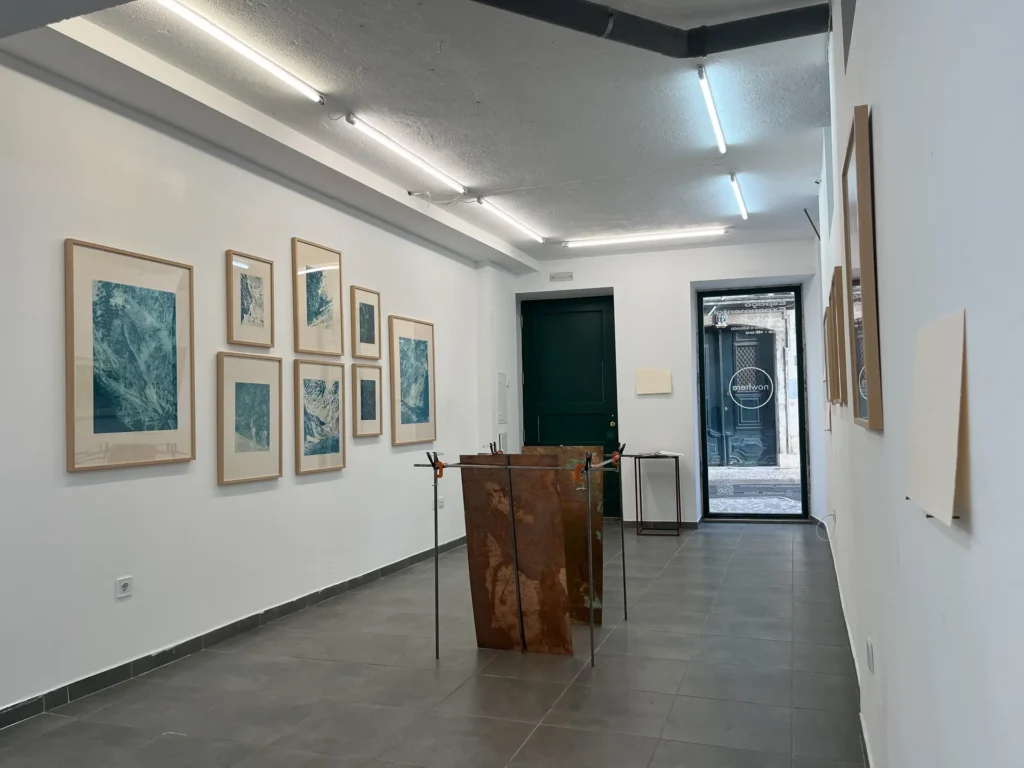
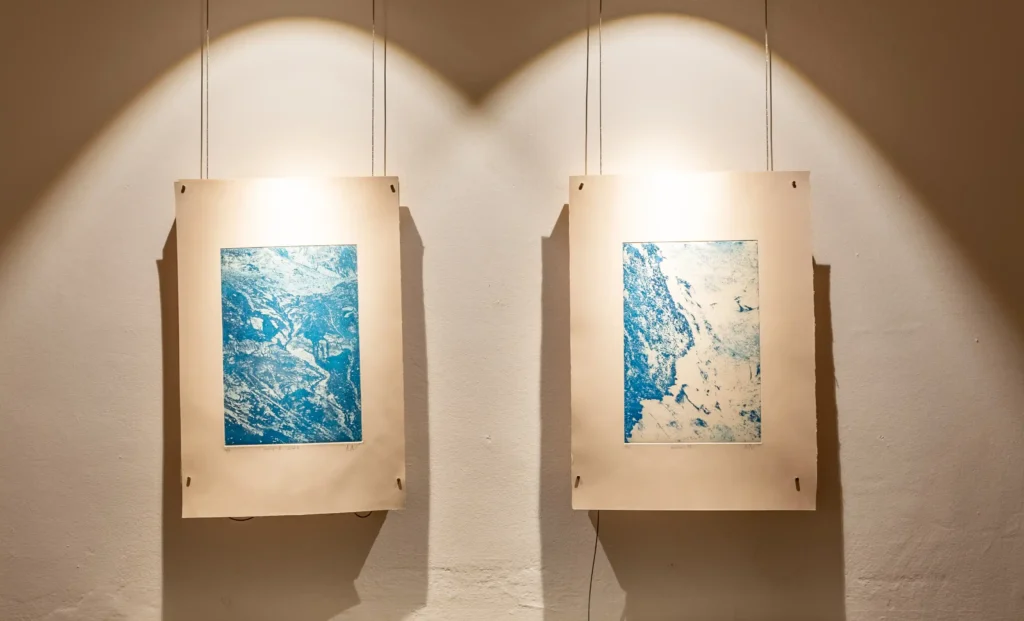
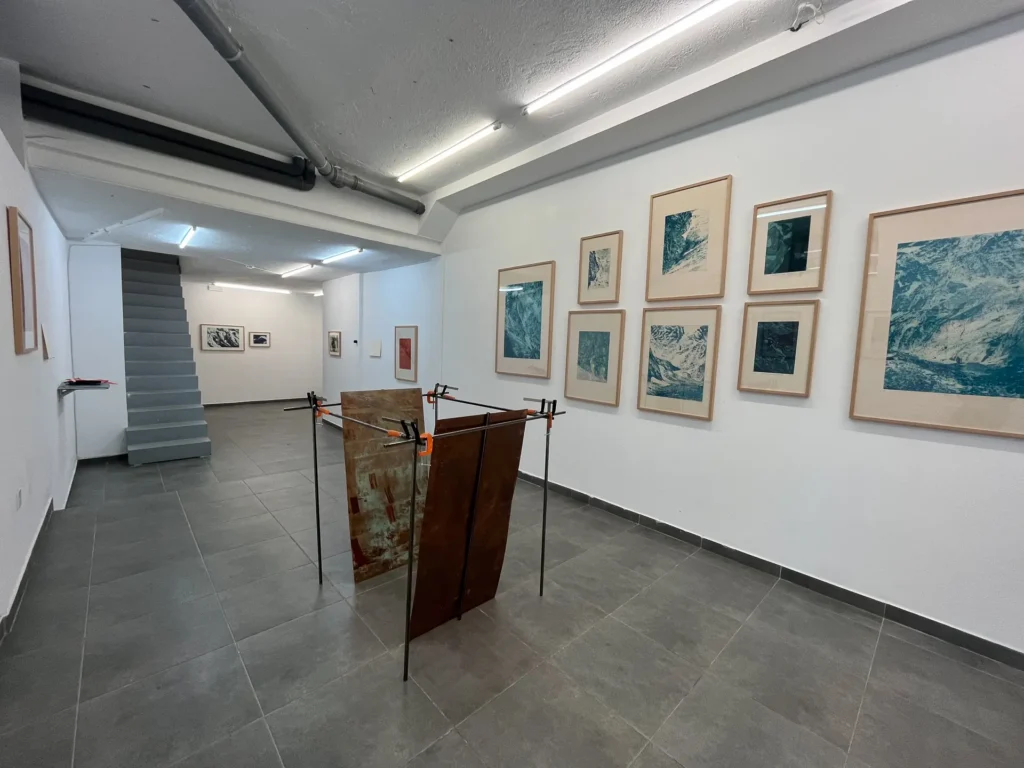
A series of nine etchings (aquatint photogravures) and a sound installation. Photographs of the glaciers of the Mont Blanc mountain range, on the France–Italy border.
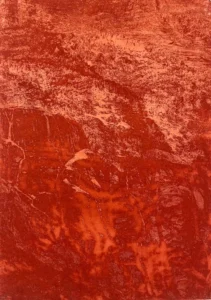
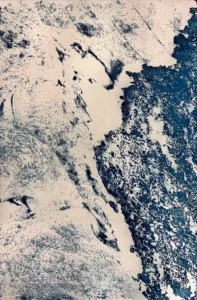
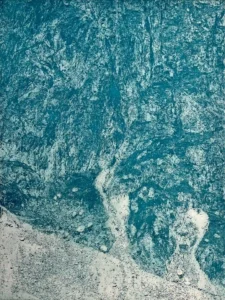
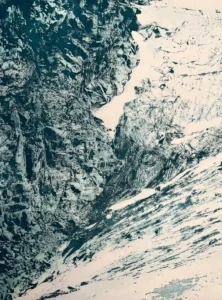
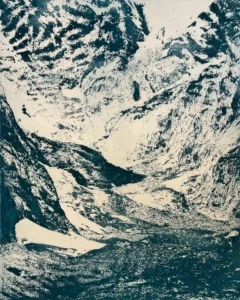
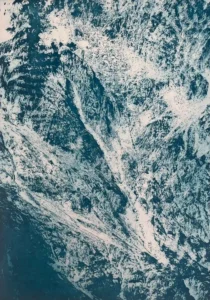
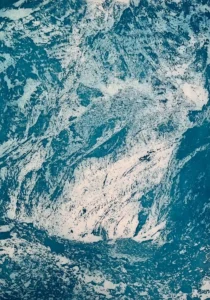
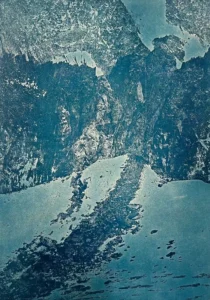
- Vertigo I_ etching_ edition of 7_ 50x35cm
- Vertigo II_ etching_ edition of 8_ 50x35cm
- Vertigo III_ etching_ edition 7_ 70x50cm
- Vertigo IV_ etching_ edition 7_ 50x35cm
- Vertigo IX_ etching_ edition 7_ 70x50cm
- Vertigo V_ etching_ edition 8_ 70x50cm
- Vertigo VI_ etching_ edition of 8_ 70x50cm
- Vertigo VII_ etching_ edition of 8_ 100x70cm
- Vertigo VIII_ etching_ edition of 7_ 100x70cm
- Vertigo X, out of series_ etching_ edition of 3_ 70x50cm
Text: David Revés, Flavia Regaldo, Teresa Siewerdt
Voice: Pedro Domingos
Contributor: Tiago Matos
After Departure
After Departure is a work that delves into the mineral matter and its human-cosmic dimensions. A work about time, mountains, and affections. A journey guided by printmaking and nourished by photography, video, sound, and text.
I come from Minas Gerais, in Brazil, a state where the disappearance of mountains due to extractivism is a historical constant. The project After Departure originates from previous works related to mountains, stones and the colonial ground. The works explore ways of symbolising contrasts between dimensions and erasures. Between natural time and human time, between construction and disposal. Here, magnitudes oppose and merge. Human time joins cosmic time through the extent of its mythology, tales and wonderings. The counting of geological time accelerates with the collapses of the Anthropocene. In several of my works, this dual perspective is central to understanding historical relationships and the constitution of collective memories and fictions.
The journey of After Departure begins with my personal narrative, marked by the sensitive collapse of a long-standing love and artistic partnership, coinciding with the landslide of a large stone in the house shared with my partner in the mountains of Minas Gerais, our common research space. The fall was consolidated by the political collapse of my country that same year, the mark of yet another erosion. Fleeing through other mountain ranges, the paths open up to explore new fictions of body-geology.
Hole: in Minas Gerais, the stones are devoured. Blood-red ore is extracted, travelling along new routes, distinct from those once traversed by gold.
The Tapir Head was an Ox: in my new home, the rocks mimic the movement of the sea.
Eruption, About Affections, Roar and Breakers: forever, volcanoes explode, destroy and fertilise the earth. A perpetual cycle of non-linear history.
Vertigo and Lapse: the melting of glaciers, the fear of the end manifests itself as social vertigo.
A project that seeks to capture the movement of the mountains.
In both lands, new perspectives on love. Reconstruction can only be mediated by affection.
"Open Studios", Cité Internationale des Arts 2023 _ Paris / France.
"After Departure", NowHere 2024 _ Lisbon / Portugal
"Worlds that Hold On, Worlds that Creep Up", Seidlvilla 2025 _ Munich / Germany
Vertigo_sound installation text
David Revés, Flavia Regaldo, Teresa Siewerdt
Vertigo_sound installation text
David Revés, Flavia Regaldo, Teresa Siewerdt
Text for the sound installation.
Created through unconscious writing, based on an exercise proposed by the artist during her artist residency at the Cité Internationale des Arts_2023
DAVID REVÉS
I'm by the window. Smoking a cigarette. I see the smoke coming out, its curls mixing with the invisible air. It's cold outside, and people down there. Unaware that I'm watching them — in their mundane and perhaps monotonous lives. There's something that pushes me. A feeling that is both pleasant and sickening. I imagine myself jumping, and I imagine the time between the jump and hitting the ground. Splattered, legs and arms broken. Eyes out of their sockets. The cigarette slowly burning next to me. I don't yield. There's no way to do it. That desire is just morbid curiosity, but it's well-watered with fear. A lot of fear. Fear of the nothing that follows. Or the possibility that this nothing is indeed empty. A round, hollow nothing. Mundane and monotonous. Without glory, grace, or light. Freezing cold. The kind we no longer feel but is there. Rotting the fingertips. 50 degrees below zero. The eternal darkness of a closed coffin underground. Beneath a stone that moves only to welcome a new companion, equally motionless and monotonous.
But the window where I am is just that. A window. Open to a void that, being physical, spatial, doesn't cease to be equally psychological. A void of thought? An impossible equation. Falling is nothing more than losing verticality. It shall happen to everyone. Lying down or turned to dust. "From the stars you came, to the stars you shall return," someone said. And said it well. The fall is, after all, a process of lifting, of letting go of everything that has always overshadowed us and pressured our heads. The pressure of the hand that rises to help us walk, talk, gesture, smile when we should smile, answer at the right time or keep quiet at the wrong time. Is falling an act of liberation? Perhaps, but painful. But it is only for those who imagine that fall. I hope. I hope it is not for those who have already fallen and lie on the ground, without pain because already without a body.
I said without humour. And I think it’s right. There's no ascent in the fall. Not during it, not after. There's only the fall. After that, just a state of confusion. That is, an indistinct continuity between the body — that body that will no longer be ours because there will no longer be an "us," an "I" — and the ground. The fall is already in the gleaming apple still attached to the tree, as it is in the apple that rots in the ground. It's in the worm that eats it from the inside, as it is in the varnish that masks it on the shelves of any large commercial surface. The fall is the act of existing. In any place and dimension: conscious or unconscious. And to exist is always to exist in a fall. Always a game — a dance — between losses and gains. Although without the need for final reckonings. At least for us, clumsy grocers bad at keeping accounts. Not even the Sun is eternal.
Looking at it from this window, I know that. And I know that this sun full of itself knows it too.
_
FLAVIA REGALDO
abyss
at the top on the edge, on the last cold and wet thread,
on the trace of the stone.
down, the abyss.
impossible to look at.
to dive is dark in the night?
cold fingers feel the ground.
fear, is desire to throw oneself.
dread, is desire to fly - to see oneself dissolving in the air.
vertigo eats inside like a worm to the top of the mouth.
a knot embedded in the hard flesh, in the solid surface of the millennia-old stone that clings to the last line of logical word.
down there, an ocean of foamy water, lava that slides and tries to pull me with its tentacles.
is it ghosts? or particles gathered in projection? like the dust that becomes visible in that sliver of sun coming through the window.
light does not reach the bottom, it hovers on the surface, on the thin and light layer.
the abyss is vertical.
it's a whole body standing, looking at itself, at the toe.
it's the feeling of something unfolding from the skin, from the sweat that drips from the smell of what is heard.
and maybe without realising it, the leap becomes a somersault in the sphere of fear and emptiness, in full contact with the viscous side. to fall. the body. and erase itself in the wind.
on the edge.
at the threshold.
on the line, the limit
at the contact of each cell of the body - with the air.
In the breach between sludge and stone, one slips
the fall is fast,
not knowing the limit between life and death,
the universe and the pulse within each being.
if there is no barrier, it's like entering the water and not recognising which part of the body is wet.
the fall - is pressure.
it's speed
it's brutality
tear
it's silence
it's the vertigo of not knowing the bound of insanity,
the stone's viscera.
the fall is gas
it's wind
light
lightness lava.
one floats, when ceasing to fall.
floating becomes the orientation of sides.
without front, back or behind, the hovering in all directions
speed reconfigures itself into metamorphosis
gravity, into whirls and spirals.
when I was little, I played jumping from the top of a wall with a blanket
the woven fabric of civilization
in the web of cotton,
in the weaves and feelings of humanity.
what remains from the jump is this cloth, memory of earth,
memory of the future, a place of refuge.
but unlike the abrupt fall of the childhood,
the end does not come.
I continue to fall together with the entire landscape.
the stones fall along, at greater or lesser speeds.
it is as if the small pebbles want to accelerate more than the rock,
the weight of one or the other doesn't matter.
it's the internal propulsion of one having fun counting the widening of space.
it's the possibility of stretching distances like a pink chewing gum that you pull to the end with your hands.
the small iron letters, from the same entrails of the rock, think about surpassing and gaining space.
in distance they see growth, and expansion.
words find a path,….. and a conversation or two begins to emerge
they are voices
they are the first caresses that the stones can manage
-hey you, come here
words are smoke, and in the fall, they rise.
the fall is exploding in all directions
the fall is ascent, it's energy expanding
the fall is the vertigo of the circle, of the circuit.
words understand in their constitution the impossibility of tracing a straight line.
the entire forest is without parallels, growing in branches and roots in all directions
in suspension, the mountain continues to move invisibly, never at rest.
the melting ice is the water that flows inside to sprout.
growth and evaporation do not occur in just one temporal direction, but connect with all possible directions of time.
the force that comes from behind the forest insists on appearing, sprouting in between.
the arm of the mountain that grows and solidifies in the dream.
the snowy tips - slip.
a slip, and there you go, a small impact leads us to believe in the abyss again.
all at a standstill, we are afraid to continue a flow, of which we don't know how to be a part off.
like regulating the words that sprout.
thought is blocked in the supposed weight of the body, a body that looks down again
and sees below what it believes to be a linear timeline.
__
TERESA SIEWERDT
I observe from the shoulders down at my shoes, stepping on an immense glass platform built on top of a cliff. Below the platform, one can see bare rocks and patches of vegetation. They seem tiny and, at the same time, gigantic, distant, and extremely close. They are simple and beautiful. Considering the weight of the body, the density of the air, and the speed of the wind, I speculate that my body would take approximately 14 seconds to fall to the rocks and vegetation. Involuntarily, this landscape merges with my gaze like a portion of a galaxy around a black hole. Reason is not enough, and the feeling of vertigo equals the force of a river current pulling towards somewhere outside of myself. It's like an invitation to leave the center and explore the margins.
They say that this glass I'm standing on is unbreakable. To believe in this glass, one must have faith in humanity, in its technological prosthetics, in the promises of infinite progress, in rockets and submarines, in the sense of war, in global trade, in the art and stock markets, in cryptocurrencies. But my body doesn't trust any of that.
And if this glass was to break? In fact, it most likely has already broken. How long ago? 50 years, 150 years, 500 years? Bodies fall, worlds fall. How much time do we still have in free fall? The worst part is not knowing how long the wait will last. What to think, what to do during this time. Will the world end? Is the world ending? We are close to the collision. Thousands are now plummeting from the top of the glass structure. Some wait indifferently for the arrival of the end, a "game over," while others imagine ways to land and "postpone the end of the world" and invent a science to survive.
I was told that there is no up or down when it comes to cosmic objects. Knowing is both falling and rising. To die and be reborn as part of something else. The topography of a Möbius strip. The possibility of inverting a negative sign to positive in a matter of seconds.
While living, waiting, or imagining, time dances, returns, falls, spins, overlaps, and stumbles over itself. The shape is a spiral. It draws dynamic forms that blaze and serpent through the sky, like a multicolored ribbon tied to the end of a wooden stick in the hands of a child.
Once again, I face the shoes. This time, they are no longer worn on the feet or on a glass platform. After the vertigo, I learn about new possible beginnings.