Flavia Regaldo
Traslador
Flavia Regaldo / Aruan Mattos
Programming: Dalton Sena
www.traslador.org
2013 - 2014
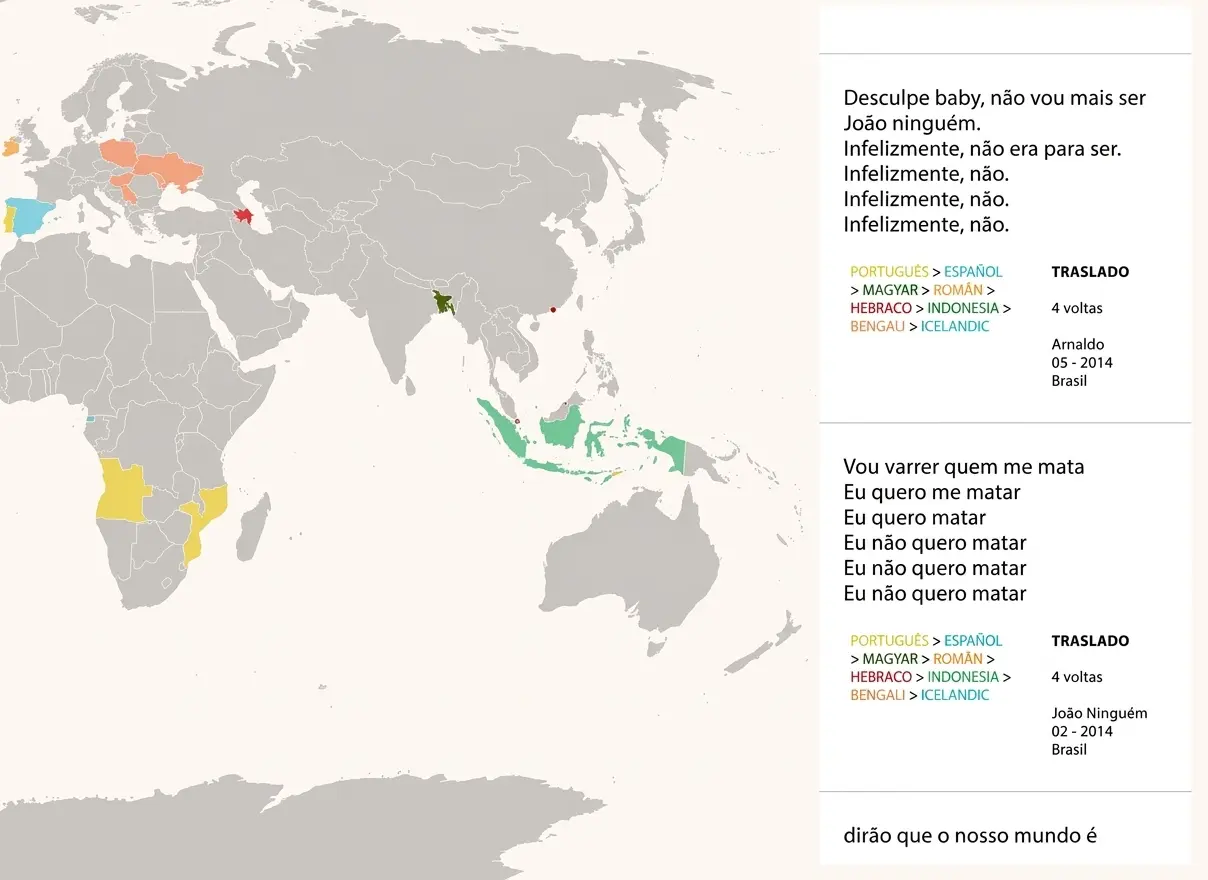
What would happen if a sentence travelled around the world and returned to the country it came from?
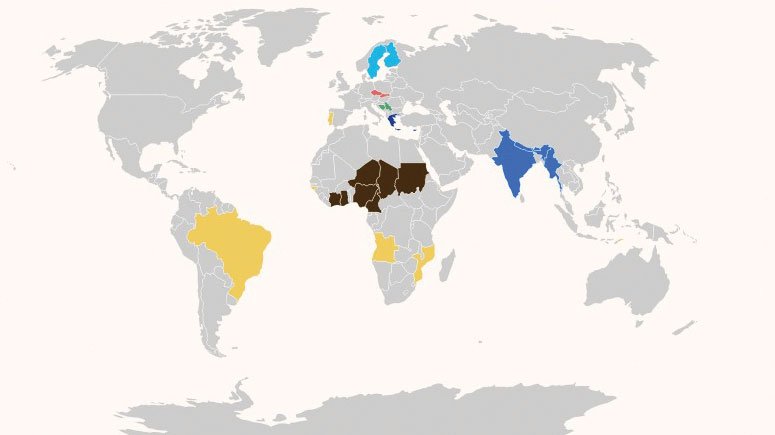
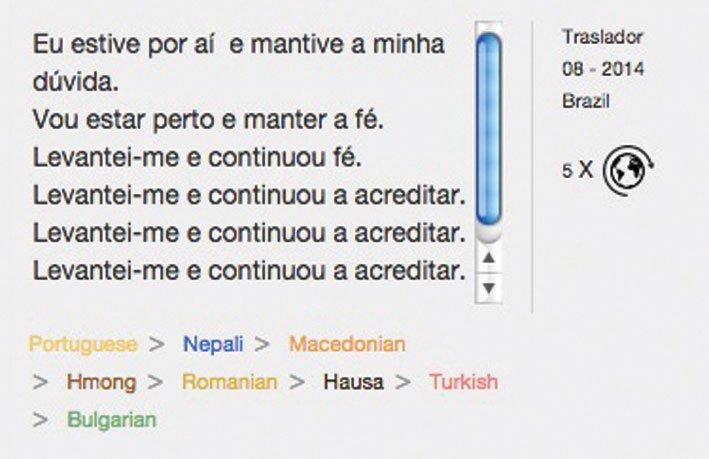
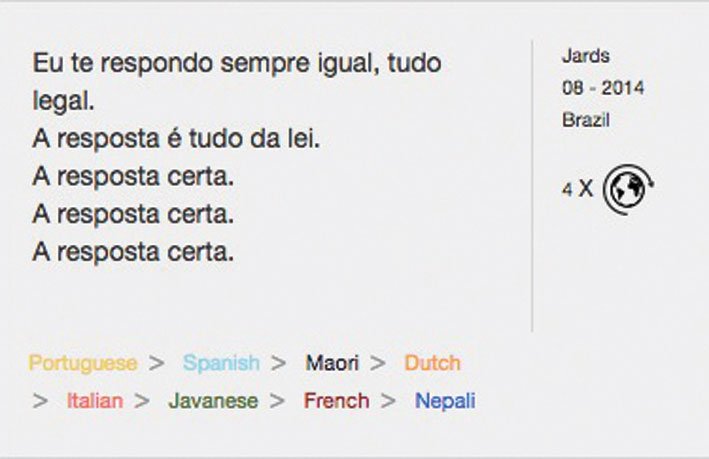
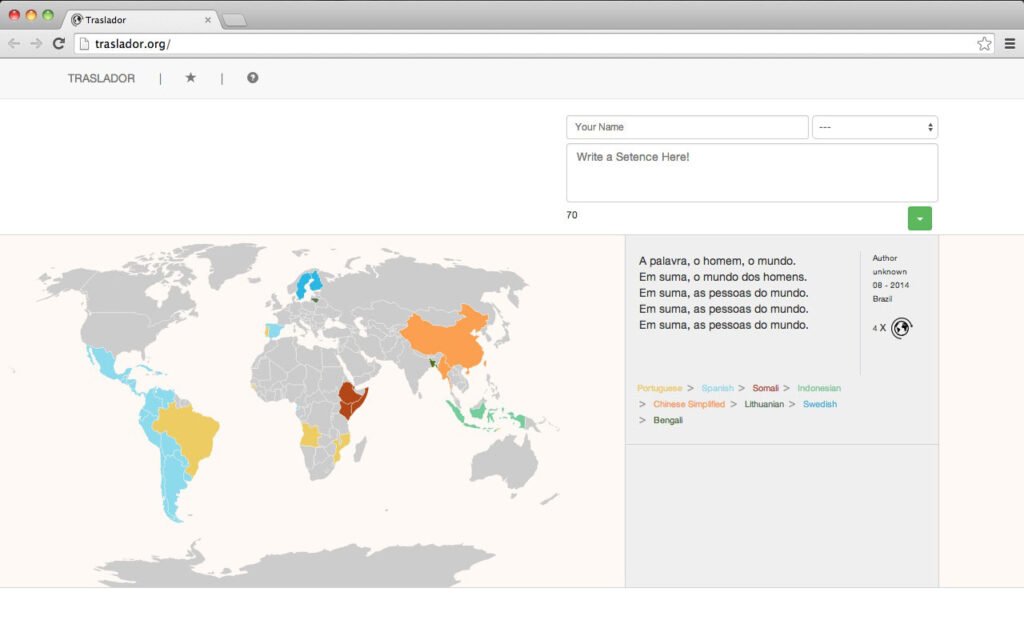
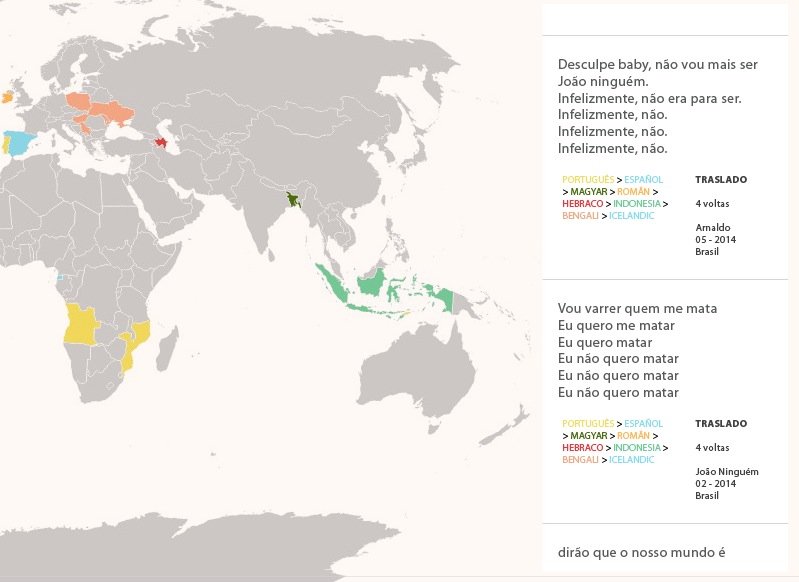
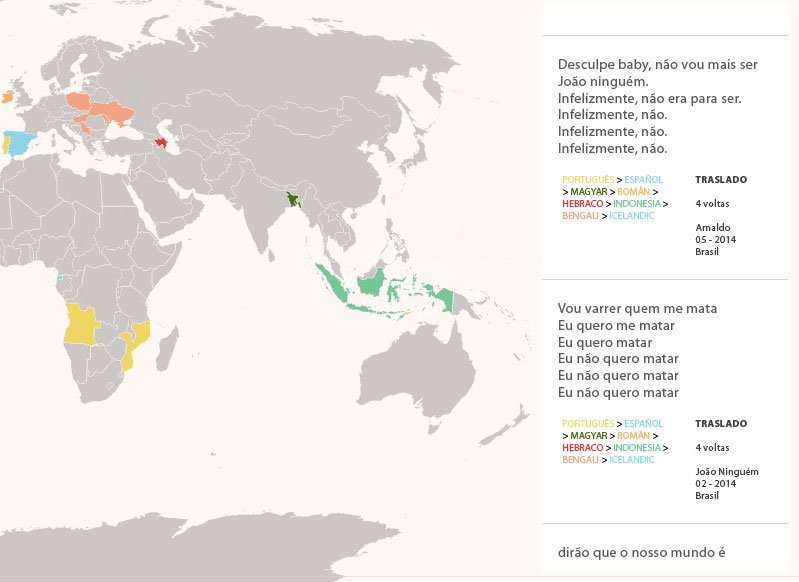
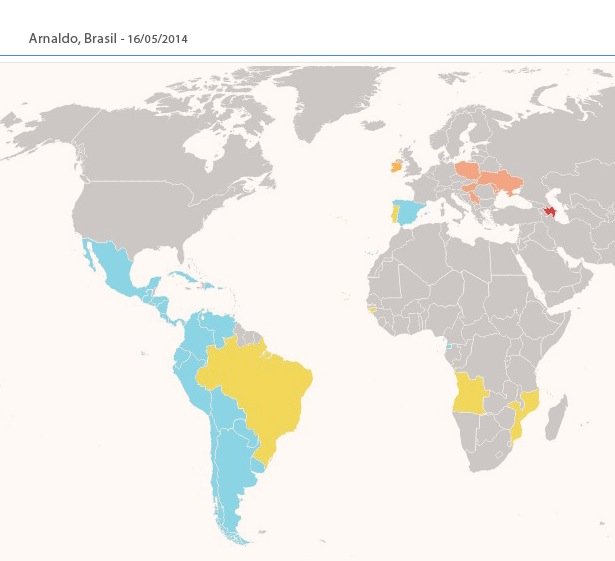
Traslador is based on this principle. Using Google Translate as its translation engine, TRASLADOR generates a cycle that randomly passes through seven different languages and ultimately returns to the original language in which it was written. Surprisingly, after a few cycles, the translation stabilises.
The translations are generated in real time on the project’s website.
Swamp
Aruan Mattos and Nian Pissolati
Swamp
Aruan Mattos and Nian Pissolati
published in Facta magazine – Hacker Culture
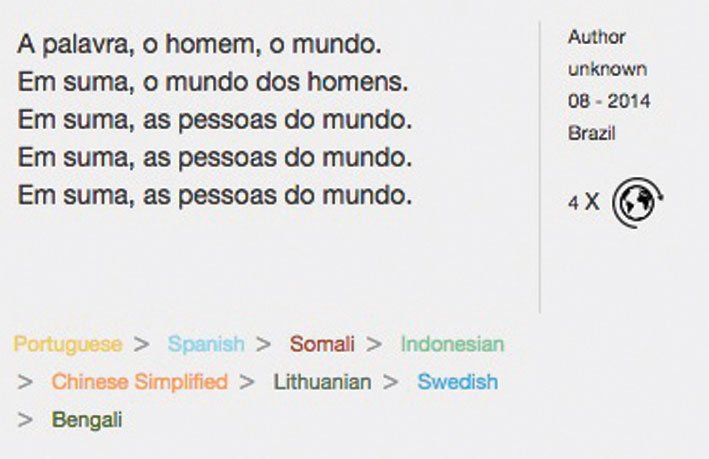
The word, man, the world.
In short, the human world.
In short, the people of the world.
Language, a cascading machine for making words, pours out as many of its pieces as it can, constructing games in which the order of the factors changes the result. Language, an enormous being that swallows the world precisely as it fabricates it through people’s mouths.
Man, who invents the world.
The world of beings who make words is the world of beings made by words.
The hall of mirrors in which the reflection of the creature is the creator is both the entrance to and exit from this world. From there, every now and then, some unsuspecting person ventures the (not so) foolish question: to name or to live?
The classic legend of the golem is well known and appears throughout history in more or less the same form: man creates a being endowed with life and at some point the creature escapes his control. The oscillation between creator and creature generates its uncontrollable monsters, beginning with man himself, or with his cherished creature, language. The moment the word comes into being, anguish over some structure becomes the movement of faith.
There have been those who saw words as living parasitic beings that use man as a host. In more fearful moments, Burroughs went so far as to claim that humanity could become extinct because of the word. Mechanisms, frequencies, and gaps created by the solidity of concatenated sounds, forming syllables, joining into words, and creating whatever it may be—even the abyss. The word as a being, though invisible under the microscope.
Jorge Luis Borges believed more in words than in things. His is the luminous verse: “y todo el Nilo en la palabra Nilo”[1]. In the same way that the concatenation of four letters generates the immensity of the river, twenty-six letters create the world. The word as the exponential creation of the world. Or precisely the opposite: language as the dreadful artifice through which man reduces the world to dust. At a certain point in “The Library of Babel,” Borges suggests that even after humanity’s extinction, the library will endure.
But returning to the opening verses:
The word, man, the world.
In short, the world of men.
In short, the people of the world.
Author: traslador.org.
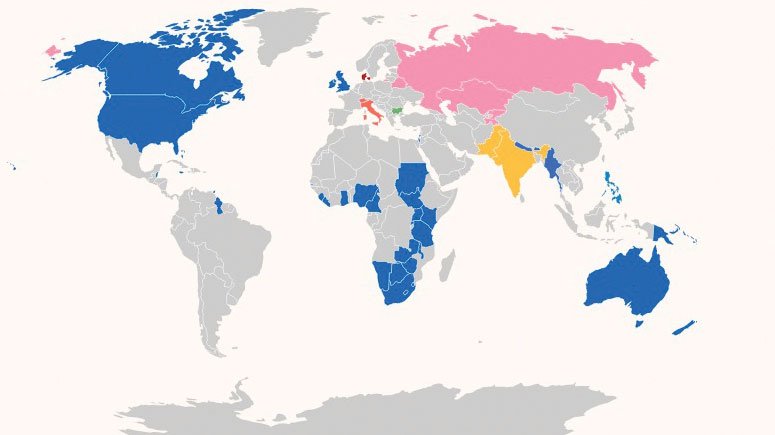
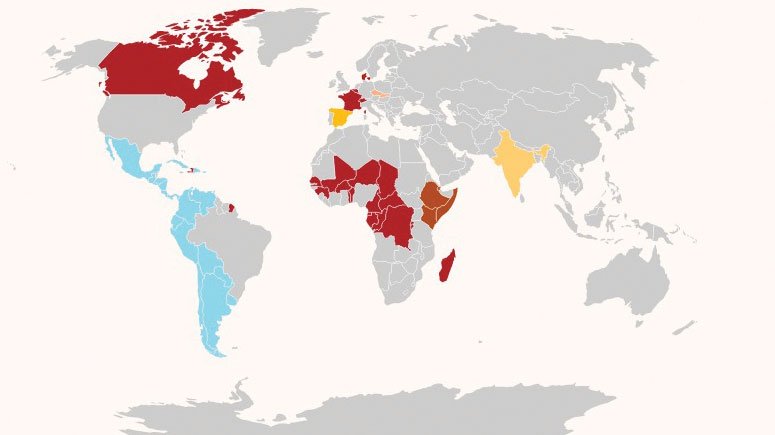
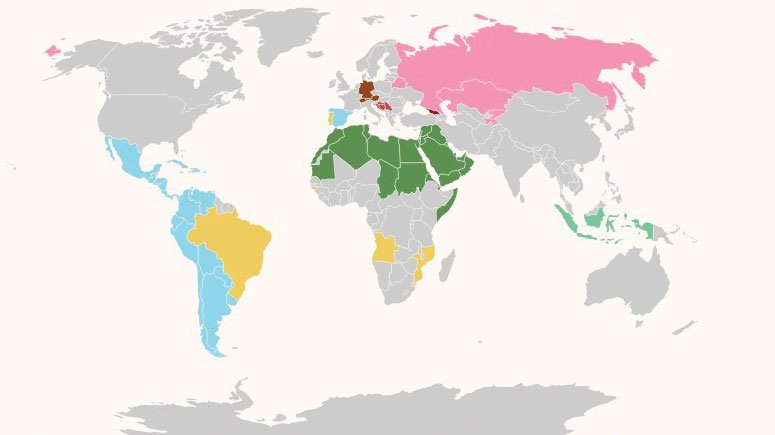
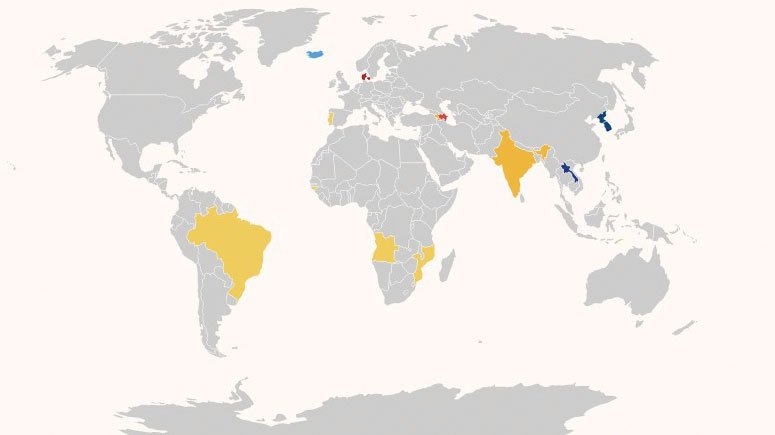
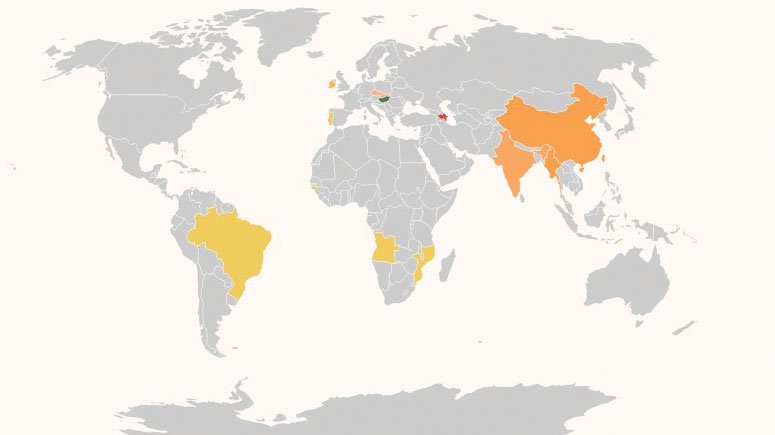
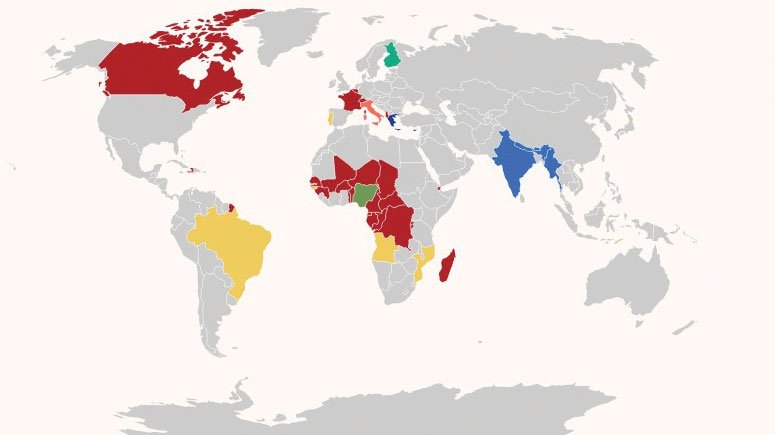
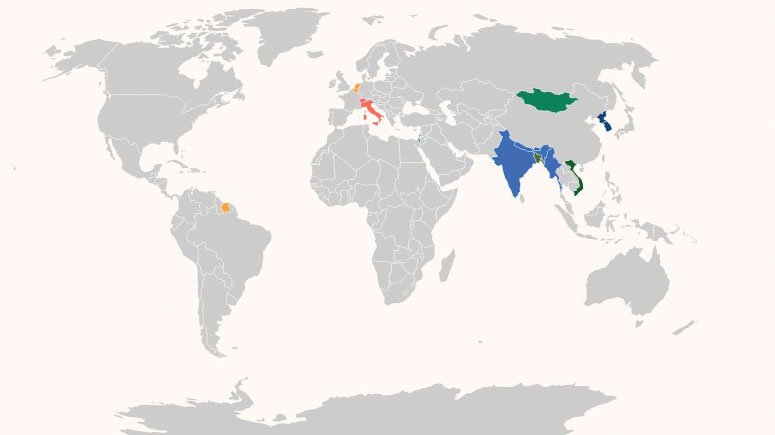
The poem was created through a process of random translation on the website www.traslador.org (which itself uses Google Translate as its platform). The first sentence came from a brain (it was written by a person): “The word, man, the world.” It was then translated into Spanish, Somali, Indonesian, simplified Chinese, Lithuanian, Swedish, Bengali, and finally returned to Portuguese. Naturally, due to the unattainable exactness of translation, the sentence returns to its language of origin in a metamorphosed form (thus forming the second sentence). This second sentence then underwent the same cycle of translations, eventually forming the third sentence. In other words, the third sentence is actually a translation of the second sentence, and the second sentence a translation of the first.
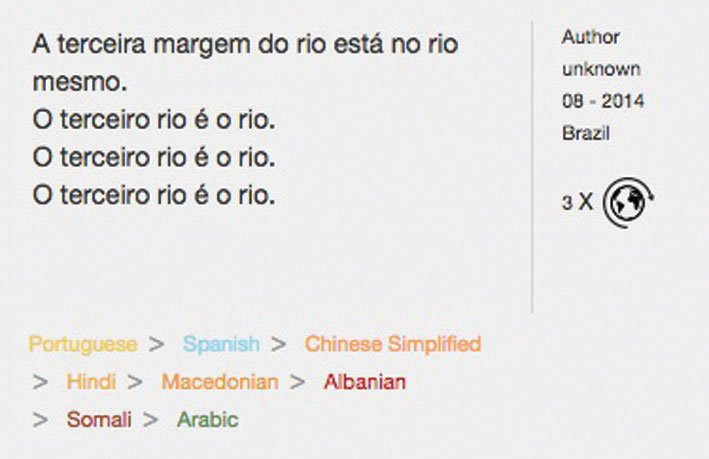
The third bank of the river lies within the river itself.
The word, man, the world. One term is missing here, one that completes and complicates the operation: the machine. The verses above emerged from this equation:
1 – the human brain, trigger for the chain that follows.
2 – machine, the platform that spins the world.
3 – word, image of human beings.
1 + 2 = 3.
In 2004 an ambitious project was created that intended to scan every book ever written by humankind and make them available online: Google Books. The project moved toward a grand and frightening reality: in theory, everyone would have access to every book. It is like the creation of the world within the world itself. The word, the world, virtualities and their power to reproduce it without ever fully reaching it. And so we traverse tortuous paths that bring us once again close to Borges—not exactly to his Library, but to the hrönir. In the story “Tlön, Uqbar, Orbis Tertius,” Borges imagines a planet (Tlön) supposedly conceived by people. Among its many inventions appear the hrönir: the duplication of an object that always presents more or less extravagant variations. As if two identical bodies could not coexist. The Library of Alexandria was burned before a copy of every manuscript in existence could be obtained. Today, the logic of the cyborg points toward futuristic nanochipped cells containing all information within all men. Even now, if everyone turned off their home computers, the internet would continue functioning like an uninhabited ocean.
Perhaps we were creating our next metaterranean heirs, our golems. In the legend, the creator, upon perceiving the creature’s imminent danger, destroys it through a magical gesture. But machines seem to present themselves differently.
In truth, long before the eighteenth century, the market, sedimentations, means of production, or foldings had already altered general relations. Still, the industrial and technological revolutions are more recent hauntings that help make a perhaps generalized feeling present. These latest mutations expand in astonishing ways and point toward a sense of irreversibility. Oscillating between human actions and velocity-driven aberrations, machines are present in the everyday life of cities. In a new form of relating to life and art, man enters into a scheme closer to the machinic—the spiritual fusion between man and machine. Logical rituals, machinic magical manifestations shape a new experimentation of the world.
According to the Houaiss Dictionary of the Portuguese Language, utility is “the capacity of a good or service to satisfy human needs,” and artificial is that which was “produced by the hand of man, not by nature.” Spontaneously, if the new man is in a certain sense the machine-man, the invention of the useful is destined toward what might once have been called artificial. Or rather, the artificial is natural (or again, the golem situation). Amalgamated into modern life in such a prestidigitously natural way, the machine adapted itself to man and man adapted himself to the machine. Historically, its useful capacity to relate events guaranteed its prolonged and, in a way, immortal existence.
In practical times, the speed of light is cruel to whatever stands still, and pause can easily be regarded as uselessness. If the useless is what does not collaborate with the social-robotic order, its elimination is the most certain destiny. The accumulation of settled dust can bring down an electronic apparatus. In an imaginary city—not very distant—the imminence of annulment is suggested in any approach to feeling and meaning. Whatever strays into unprogrammed paths is subject to invalidation, and this situation generates a generalized fear of nonconformity. But would fear itself not already be the contrary propulsion? The machine fails when it plays with what is against it, since what is against does not play by other terms. In the search for assertive and unilateral logic, it culminates in its antithesis: death and life. To this are added the still-unrestrained forces: day and night, gravity and ascent, fungus, corrosion.
On the other hand, ironically, the speed of vagueness may come closer to an objective than traditional objectivity itself. In a state of practical logic where swaying is demeaned, the man who wobbles seduced by corrosion does not aim at the futuristic. His hopeless sway rejects expectation and its explosion condenses into the present. In each second of big bangs and possibilities, eternity emerges from the life and death of every second.
Paradoxically, pause points toward the infinity of the instant.
There is a swamp on an island where plants are more impatient in birth than in death. The emergence of light without embryo contrasts with sticky, moving putrefaction. One game is trying to remember the beginning of the conversation; another is trying to remember the beginning of thought. As bacteria reveal bubbles on the surface, the plants lean over one another. One game is trying to remember the end of the conversation; another is trying to remember the end of thought. When the bubble bursts, it splashes sticky liquid onto those plants. Some cannot withstand it, putrefy, and amalgamate with the liquid. Others are expelled by rain or wind. Others carry the sticky liquid.
[1] In the essay “The Muse of Impossibility” (published in issue 6 of the journal Serrote), Alberto Manguel draws connections between Borges’s work and the figure of the Golem. Here, we depart from this analogy toward other unfoldings.
In writing this text we were also freely inspired by the following works and authors: Adolfo Bioy Casares; Alberto Manguel – The Muse of Impossibility; François Truffaut – Fahrenheit 451; Gilles Deleuze and Félix Guattari; Jean-Luc Godard – Alphaville; Jonas Mekas; Jorge Luis Borges; William Burroughs.